
Sony 10-18mm F4
Don't like the alternatives?
Choose from the full offer
Sony 10-18mm F4
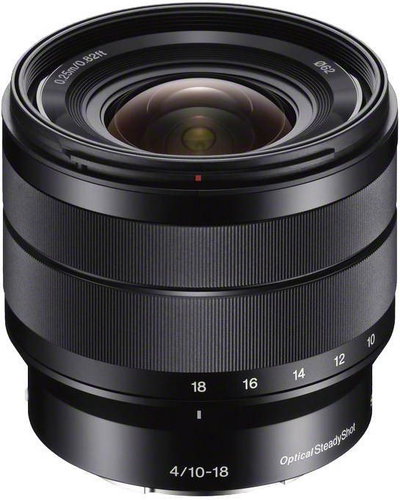
Due to its focal length, this compact widescreen SONY lens, is ideal for indoor and outdoor photography such as capturing long cliffs or endless beaches. The maximum magnification 0.1x with a minimum focusing distance of 25cm offers extremely bright life-size details. Extra ED low-dispersion glass reduces the occurrence of chromatic defects. It ensures higher image quality even at focal lengths of 10mm. The short focal length design is a guarantee of high-quality optical performance, lightness and easy portability.
The SteadyShot optical image stabiliser delivers detailed and unobtrusive hand-held results, especially for night scenes or poorly illuminated interiors. With the easy-to-grip ring on the lens body, gently sharpen the subject or blur it against the background. The brightness reaches F4 in the full zoom range and the lens features a 7-blade circular aperture for more natural, rounded defocusing or ‘bokeh’. The filter has a diameter of 62mm. Also included is a practical lens hood.
Parameters and Specifications:
Type:
Wide-angle with short focal length
Intended for:
SONY NEX cameras
Focal distance:
Basic: 10-18mm
Conversion to 35mm using APS-C sensor: 15-27mm
Aperture:
F4
Angle of view:
109° - 76°
Aperture:
Type: circular
Blades of the diaphragm: 7
Min. Aperture: 22
Minimum focusing distance:
0.25m
Maximum magnification:
0.1
Filter Diameter:
62mm
Dimensions:
70x63.5mm
Weight:
225g
Accessories:
Front lens cap
Rear lens cap
Lens hood
Specifications
Bayonet
Features
Functions
Dimensions
Weight
| Code: | OS030n3 |
| Links: | Producer's Website: |
| Manufacturer information |
Sony Corporation is a Japanese company founded in 1946. Its headquarters is located in Tokyo. Its beginnings were humble. The first product sold under the Sony brand was a transistor radio. It was those radios that played a pivotal role in the company's expansion in the 1960s and the world quickly began to associate Sony products with a reliably stellar price-performance ratio. In the 1970s, Sony was severely affected by the global economic crisis. Many analysts considered the company effectively defunct and could see no future for it. However, they underestimated the famous Japanese perseverance and courage. The crisis was not a disaster for Sony; on the contrary, it served as a launching pad to even greater heights. The company recovered and soon changed the media landscape with the development of the CD and later the DVD. In the early 1990s, Sony achieved another major success with the introduction of the PlayStation gaming console. It is the gaming consoles that best represent the intersection of the three key areas in which the company operates today – electronics, video games, and the entertainment industry. 
|