
How to Choose a Power Bank
Battery life is currently the achilles heel of smartphones, tablets and other devices. But there is a solution - power banks. They are compact, affordable and do not take up much space. There are many power banks on the market that differ in capacity, connectors, design, etc. We will help you to choose the right one.
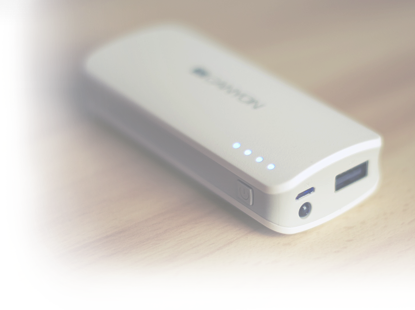
Tips for choosing a power bank
- When looking for one, keep in mind which devices you want to charge and how big their battery is.
- Are you buying a power bank just for yourself or will it be used by more people?
- Do you need to charge your devices as fast as possible or the speed isn't the priority?
- Are you looking for some extra features that your power bank should have?
Important power bank parameters
Power bank capacity
Capacity is, of course, one of the most important features of any power bank. On Alza you will find them divided into the following categories:
- Up to 5,000 mAh - a very small power bank that will fully charge your mobile phone once.
- 6,000-9,000 mAh - perfect for work or school. On average, it will charge your smartphone two times.
- 10,000–14,000 mAh - suitable for all-day or two-day trips. They should charge 3 smartphones on average without any problems.
- 15,000–19,000 mAh - for shorter multi-day travel. This power bank can charge the phone up to 5 times.
- 20,000–29,000 mAh - great for longer multi-day trips with a group of people. Usually provides about 8 charges, so you can juice up other people's devices.
- Above 30,000 mAh - power banks for the most demanding ones. They can charge a smartphone more than 10 times, making it suitable for a holiday in remote places.
Usable capacity
Usable capacity is even more important than the stated capacity. Substantial is the percentage of the battery efficiency, which can be found in the specifications. Thus, a 15,000 mAh power bank with 80% efficiency would have a real capacity of only ± 12,000 mAh. Also, different voltage levels of the power bank and USB interface can cause loss of capacity.
Output current
Now that we know how much power a power bank can hold, it would also be useful to know how quickly it can transfer energy. This is determined mainly by the output current of the power bank. Most often the values are either 1A, 2.1A or 3A. While 1A output is used for charging smart watches or similar smaller devices, 2.1A and 3A (possibly up to 5A) are more suitable for larger devices. With these, you can quickly recharge not only smartphones, but also laptops .
Output connectors
Not only compatibility with your device, but also some other features depend on the output connector. The most common outputs include USB-A, Micro USB or faster USB-C or Lightning output. You will most likely use these outputs when charging mobile devices or laptops. There are also power banks with AC output or with car start connectors (to charge car battery).
Other functions
Many power banks have similar specifications, so additional features will be those that decide. There can be many of them. For example:
- Quick charge - Charges your devices faster. Charges your smartphone in half an hour.
- Wireless charging - The popular wireless charging has also made its way into the world of power banks. If your device supports it, give it a go.
- Solar panels - a little unusual feature is solar charging. Such power banks are equipped with solar panels and receive energy from the sun.
- Multiple outputs - it is quite common that a power bank has two or more outputs. They often differ in output voltage and type.
- IP protection rating - you may want to travel off-road with your power bank. In this case, you will need good quality one with an IP certificate.
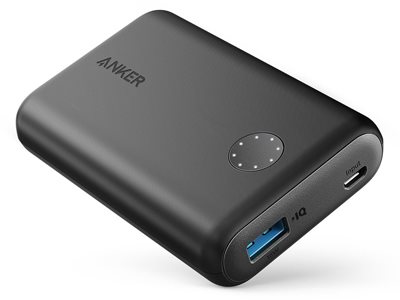
If you don't want to put too much energy to choosing the power bank, you may need just the basic one. It usually offers sufficient capacity for one person for one or two days and does not offer any special features. Such power banks usually have USB output and are suitable for most mobile devices.
Advantages and disadvantages
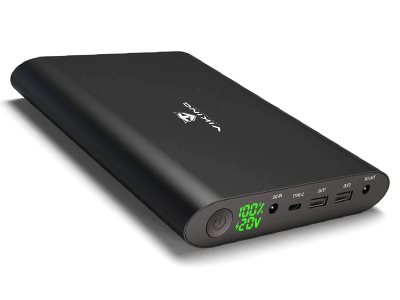
Do you want to buy a power bank, but don't want to lose even one extra minute? Power bank with quick charge support will be perfect for you. If your phone also supports quick charging, you will only need about an hour to fully charge it. In addition, some quick-charge power banks are not much more expensive than the basic ones.
Advantages and disadvantages
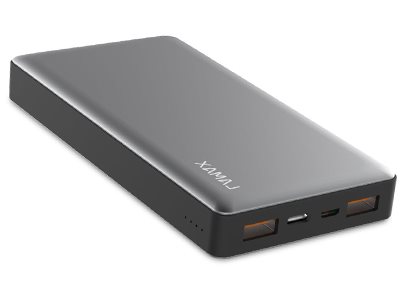
If you own one of the latest Android phones, you probably need a power bank that has a USB-C output. The advantage of this new connector - in terms of power banks - is higher maximum charging speed, so if the USB-C power bank has fast charging support, you can be sure that you won't wait too long for charging.
Advantages and disadvantages
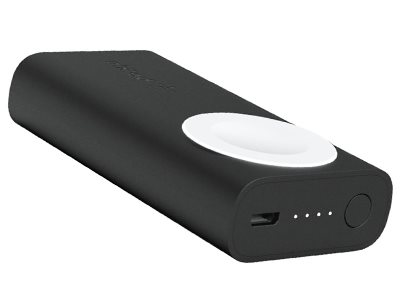
If you don't plan to travel with a power bank but you want to take it eg. to work, and you have devices that support wireless charging, you will love these power banks. You simply put your smartphone or smart watch on the power bank and that's it. You don't have to carry any extra cables, but if you put your power bank and mobile phone both in your backpack, you probably won't get the desired result.
Advantages and disadvantages
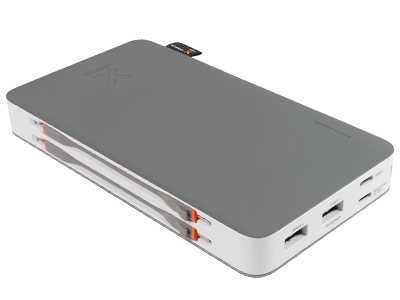
Power banks for laptops are not different from the other ones. Except for one parameter, and that is capacity, which is usually higher. Charging speed is also slightly higher so you can work on the laptop while it is being charged. Otherwise, power bank for laptop can be used even with tablets or smartphones.
Advantages and disadvantages
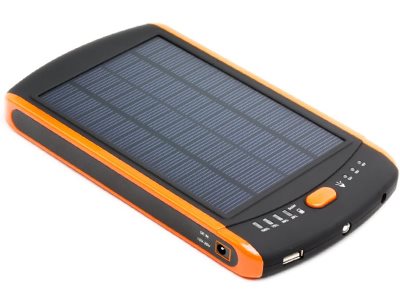
If you travel often to the countryside, you could take advantage of it and borrow a little bit of energy for your device from the sun. Some power banks have solar panels, which can charge them a bit. In order to function properly, solar power banks must always be facing the sun directly, so you will probably have to find a power outlet anyway, but one free charge a day doesn't sound bad, does it?
Advantages and disadvantages
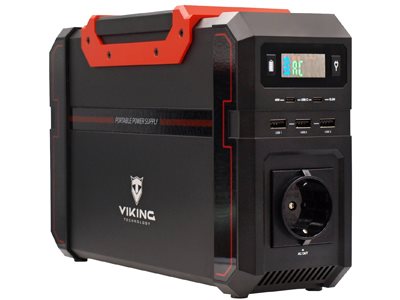
Charging stations can be called “power banks for the most demanding ones”. These are large boxes with a huge capacity of over 100,000 mAh (400 Wh at 4 V), which have besides USB outputs also power outlets that we all use at home. The advantage of charging stations is the possibility to charge any electrical equipment and even appliances such as electric grill. With some charging stations you can also buy solar panels.
Advantages and disadvantages
Frequently asked questions when choosing a power bank
Do I need special power banks to charge tablets and laptops?
In case of charging tablets there are no problems - just buy a regular power bank for smartphones. The same goes for laptops, if you have the right cable. For laptops, however, we recommend a power bank with higher capacity and output current.
How much does a solar power bank charge?
Solar panels are still only a secondary source of power for the power bank, so don't expect miracles. The solar panel energy yield varies from model to model but on average it is about 300 mAh per hour. This may seem like an insignificant value, but in the end it is one charge a day from renewable sources and for free.
Glossary - Power bank
Battery life
Battery life is measured in mAh (milliampere hour), the higher the number, the greater the capacity. The main factors causing smartphone battery drain are - the size of the display or backlit area, the processor performance, the use of data functions or GPS.
Output current
The output current value (amperes) indicates the maximum continuous current the battery can supply. For smaller devices (mobile, navigation) 1 A is sufficient, for tablets it is usually 2.1 A.
USB
USB (universal serial bus) is the most widespread connector for connecting external peripherals and accessories not only to computers, but also to mobile phones, tablets and other devices. The most commonly used generations are USB 2.0, USB 3.2 Gen 1 and USB 3.2 Gen 2. The USB-C connector of symmetrical shape is becoming more and more popular.