
Sony DSC-QX100B Smartphone attachable lens-style camera
Don't like the alternatives?
Choose from the full offer
Sony DSC-QX100B Smartphone attachable lens-style camera
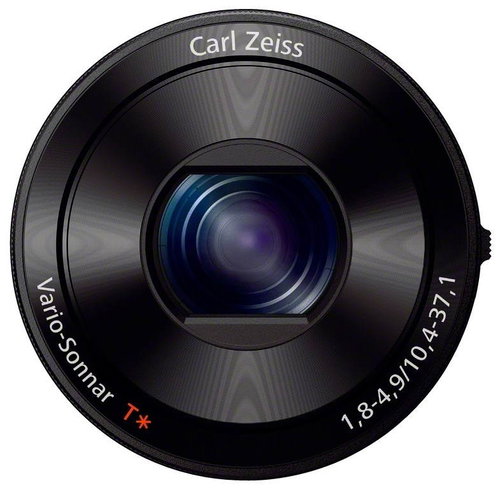
Sony DSC-QX100B links simplicity and availability shooting with a smartphone quality and properties shooting with cameras falling into the category of super zoom.
Maximum compatibility
Transform any smart phone into a high-performance camera. It really very simple. Attach the lens on your smart phone and start shooting.
From your smart phone becomes the body of the camera: using the touch screen, you can capture, retouch and share photos on to Facebook and Twitter.
Bigger is better
You now have the power professional camera on your smartphone. Exmor R CMOS sensor type 1.0 20.2 effective megapixels resolution is four times larger than the sensor in many digital cameras. You can capture detail-packed images with minimal noise even in low light.
Convenient operation
Imagine Snapshot. You have all the necessary controls to be made. Download to your phone PlayMemories Mobile, and then touch the screen to set the aperture and exposure. The control ring around the lens barrel lets you manually adjust focus and zoom.

Specifications:
Lens:Optical zoom3.6x zoom (photos and film)Zoom with a clear pictureFF1, 8 (W) to 4.9 (T)Focal Length (f = mm)f = 10.4 to 37.1 mmFocal length (35mm conversion)f = 28-100 mm (4:3 photo mode)Macro (cm)iAuto: AF (W: Approx. 5 cm (0.16 ') to Infinity, T: Approx. 55 cm (1.80') to Infinity)/Program Auto: AF (W: Approx. 5 cm (0.16 ') to Infinity, T: Approx. 55 cm (1.80') to Infinity)
Image sensor:
Exmor R CMOS sensor
Effective pixels:
Approx. 20.2 Megapixel
Aperture - Auto Mode:
iAuto (F1, 8/F11)/Program Auto (F1, 8/F11)
Aperture - Priority Mode:
F1, 8/F11 (W)
Aperture - Manual mode:
F1, 8/F11 (W)
Shutter Speed - Auto Mode (s):
iAuto (4 "-1/2000)/Program Auto (1" -1/2000)
Exposure control:
± 3.0 EV in increments of 1/3 EV
White balance:
Auto, Daylight, Shade, Cloudy, Tungsten, Fluorescent lamp with a warm light, Fluorescent lamp with cold light, white fluorescent daylight, daylight fluorescent lighting, color temperature filter
Automatic white balance
Light Metering (Multi)
ISO:
ISO160-6400 (iAuto), ISO160-25600 (Premium Auto mode), ISO160-3200 (Program Auto), ISO160-3200 (Aperture Priority)
Scene Selection
Connectors:
Multiple high-definition connector
Multi Connector/Micro USB, Hi-Speed USB
Multi-function connector
Interface USB 2.0 Hi-Speed
Battery System:
Lithium-ion
Weight:
Approx. 165 g
Weight with Accessories (g)
Approx. 179 g (6.3 oz)
Bundled software
PlayMemories Home
Included accessories:
Rechargeable battery (NP-BN)
Micro USB cable,
wrist strap,
attachment to the smart phone,
Operating Instructions
Dimensions:
62.5 x 62.5 x 55.5
Specifications
Type and function
Sensor
Video
Display
Memory and storage
Battery
Inputs and outputs
Lens
Lens
| Code: | OS149a |
| Links: | Producer's Website: |
| Manufacturer information |
Sony Corporation is a Japanese company founded in 1946. Its headquarters is located in Tokyo. Its beginnings were humble. The first product sold under the Sony brand was a transistor radio. It was those radios that played a pivotal role in the company's expansion in the 1960s and the world quickly began to associate Sony products with a reliably stellar price-performance ratio. In the 1970s, Sony was severely affected by the global economic crisis. Many analysts considered the company effectively defunct and could see no future for it. However, they underestimated the famous Japanese perseverance and courage. The crisis was not a disaster for Sony; on the contrary, it served as a launching pad to even greater heights. The company recovered and soon changed the media landscape with the development of the CD and later the DVD. In the early 1990s, Sony achieved another major success with the introduction of the PlayStation gaming console. It is the gaming consoles that best represent the intersection of the three key areas in which the company operates today – electronics, video games, and the entertainment industry. 
|