
Paper sizes: overview of sizes and series
Everyone most likely knows that A5 and A4 formats, which we all use at schools or offices, will always have the same dimensions, whether it is a workbook, printer paper or a sketchpad. The same applies to other formats, thanks to the standards that divide them. For normal paper we have formats A, B and C, but there are also different sizes for posters or photos. All important paper sizes are described and explained in this article.
Paper sizes: overview of sizes and series - CONTENTS
- How do we divide paper sizes and why?
- Formats A: not just a printer paper
- Formats B: bigger = better?
- Formats C are for envelopes
- Other formats: American and Photographic
How do we divide paper sizes and why?
Like most things in our world, paper is subject to the mutual agreement of the people who use it. In this case, however, it is not just an agreement, but a standard. Today we divide paper sizes into three basic series: A, B and C, all of which are subject to the standard ČSN EN ISO 216. Thanks to that, a particular size (A4 for example) has always the same dimensions (for A4 it is 210 × 297 mm). This not only makes it easier to work with, but also allows the existence of printers and other machines that can be designed for a particular paper type and thus be smaller and cheaper.
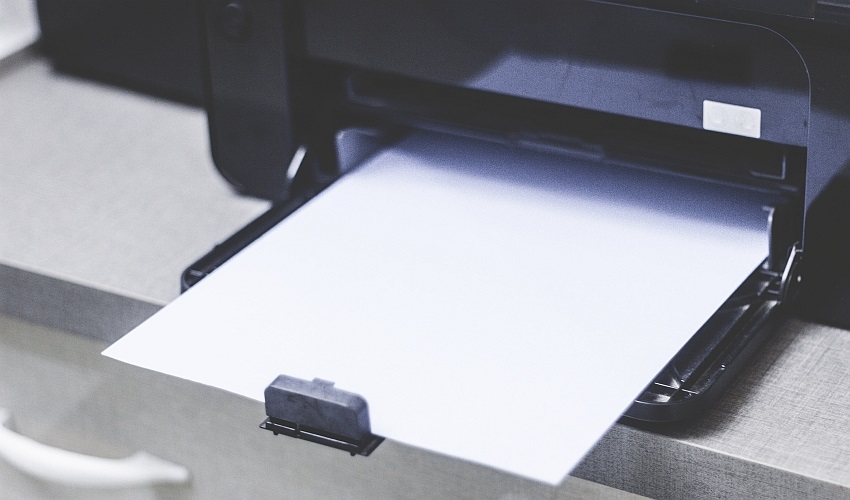
Everybody knows A4 and A5 formats as these are the sizes of regular printer papers or school books.
- The A series is the most common and widespread, with the most commonly used formats.
- The B series (B4, B5, etc.) has the same aspect ratio as the A series, but its formats are larger, so they can be trimmed to the A series dimensions.
- The C series contains envelope sizes designed to fit the A series size paper.
Paper quality is determined by a number of attributes (binders, fillers, surface treatment), but the most important one is the weight. It is expressed in the amount of grams per square meter. Usually, the higher the weight, the stronger the paper and the overall quality. However, thick paper is not always needed: for example, when storing a large paper pack, heavy paper is not convenient. Plain paper weights about 40–150 g/m2, whereas the standard value for office paper is 80 g/m2.
A formats: not just a printer paper
The best-known of all papers are A series paper sizes. The most common ones are A4, A5 and A3, but the basic range is usually classified from A0 to A8. Everybody knows the A4 size - it is the most widely used paper for printers, but also the format of large school notebooks.
A3 is twice the size of A4, A5 is half size of the A4 paper. Both of them, A3 and A5 are still commonly used, even in home and office printing.
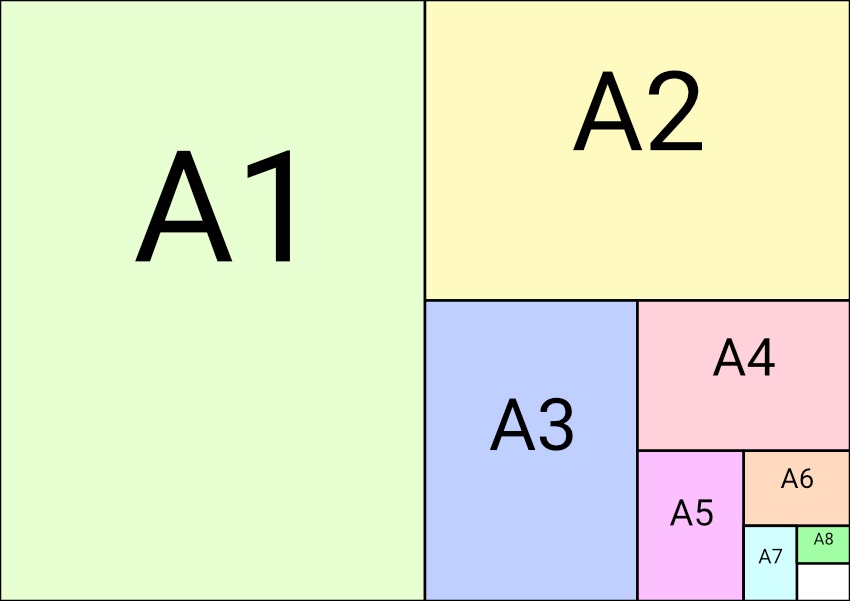
The dimensions of sides of the A series formats are not random, they are accurately calculated. The basis for calculating smaller sizes is the A0 dimension, which is used for 1 m² paper. However, it is not a square, but a rectangle with a ratio of sides 1: √2 (1: 1.4142). This ratio is sometimes called a "silver rectangle" and it gives the paper one special feature: when folded in half, the sheet always retains its original ratio. By folding A3 we get an A4 paper, by re-folding it we get an A5 sheet and so on.
| A series | Size |
|---|---|
| Format A0 | 841 × 1 189 mm |
| Format A1 | 594 × 841 mm |
| Format A2 | 420 × 594 mm |
| Format A3 | 297 × 420 mm |
| Format A4 | 210 × 297 mm |
| Format A5 | 148 × 210 mm |
| Format A6 | 105 × 148 mm |
| Format A7 | 74 × 105 mm |
| Format A8 | 52 × 74 mm |
B formats: bigger = better?
Besides the best known and most commonly used A series, we also have B formats. These are differentiated in the same way as formats in the A series, but have larger dimensions. As has already been said, their ratio is also defined by the silver rectangle (1: 1,4142), so it remains the same even when folded in half. And while the A0 base format is chosen to be 1 m², the B0 sheet is based on the short side of 1,000 mm (1 meter). And as its longer side has 1,414 mm, it is clear that the area of the B0 sheet is equal to A0 × √2 (1.4142), thus approximately 1.4142 times larger.
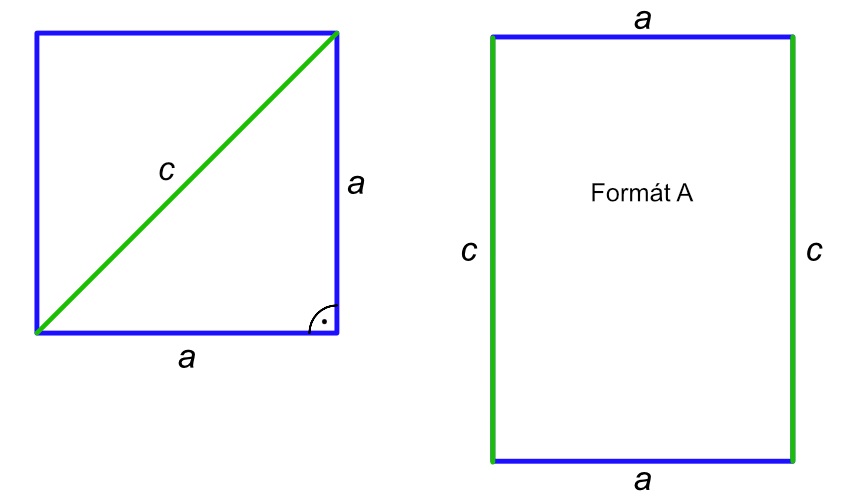
The silver rectangle is an aspect ratio with unique properties. It is based on the Pythagorean theorem, according to which the length of the hypotenuse of a right-angled triangle can be determined, if we know the lengths of the other two sides. The diagonal of the square is calculated in the same way. This is important because A4 paper is a rectangle with a shorter side of the same length as the side of the square and with a longer side of the same length as the diagonal of the same square.
If we substitute the number 1 for the two shorter sides (a, b) in the formula c² = a² + b², then we find that c² = 2 and thus c = √2. And since √2 = 1.4142, we get the desired aspect ratio of 1: 1.4142 for A formats.
B-series formats are commonly used for printing books, newspapers and also for the "bleed"" printing, which is printing graphics beyond the trim edges of the paper. To avoid a mistake in the correct allignment, which could result in an unwanted white edge, the graphic is printed on a larger paper and then cut to the desired size. A3 and A4 pages use A3+ and A4+, but also B3 and B4.
| A series | Size |
|---|---|
| Format B0 | 1 000 × 1 414 mm |
| Format B1 | 707 × 1 000 mm |
| Format B2 | 500 × 707 mm |
| Format B3 | 353 × 500 mm |
| Format B4 | 250 × 353 mm |
| Format B5 | 176 × 250 mm |
| Format B6 | 125 × 176 mm |
| Format B7 | 88 × 125 mm |
| Format B8 | 62 × 88 mm |
C formats are for envelopes
The third series, which is probably more used than the B series, is the C series for envelopes. As in the previous two series, the aspect ratio is defined by the silver rectangle and is always 1: √2. However, unlike sheets A0 and B0, size of the sheet C0 is not determined by the length of the page or the area. Its dimensions are designed so that A0 sheet would fit in the theoretical C0 envelope. Theoretical, because the C0 envelope is not very useful in practice. Commonly used formats are C3, C4, C5, C5/C6 and C6.
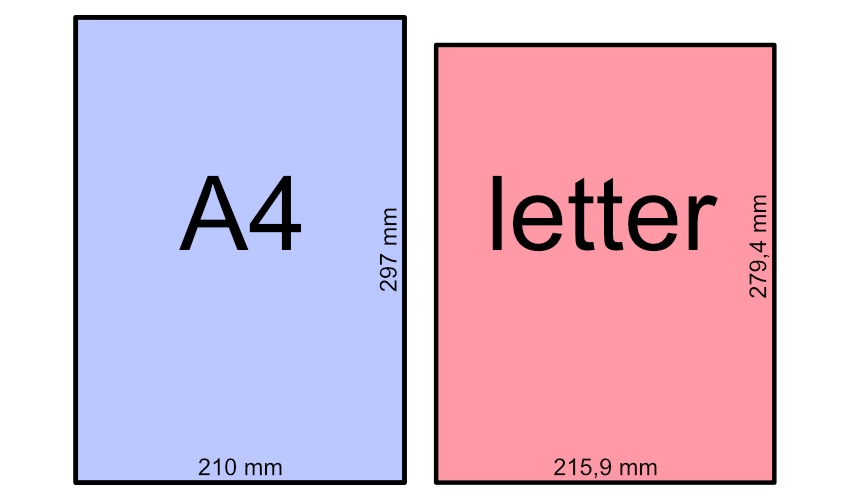
If you find “letter” in your printer settings, watch out before printing. The letter is very similar to A4 but has different dimensions and aspect ratio. While A4 sheet measures 210 x 297 mm, the letter size is 215.9 x 279.4 mm. This is because ISO 216 is accepted worldwide except for the US and Canada. In those countries they use their own formats including the letter size. If your computer has A4-formatted text and the printer paper is also A4, you should also set the print size to A4.
| A series | Size | What fits in the envelope |
|---|---|---|
| Format C3 | 458 × 324 mm | format A3 |
| Format C4 | 324 × 229 mm | format A4 |
| Format C5 | 229 × 162 mm | format A5 (A4 folded in half) |
| Format C5/C6 | 229 × 114 mm | 1/3 A4 (A4 folded twice) |
| Format C6 | 162 × 114 mm | format A6 (A4 folded in half twice) |
| Format C6/C7 | 162 × 81 mm | 1/3 A5 (A5 folded twice) |
Other formats: American and Photographic
In addition to the A, B, and C series, we can also come across other paper sizes like American standards or photo sizes. Moreover, with the exception of series mentioned above, it is common to name formats according to their dimensions in inches or centimeters. In North America, office paper sizes have their own labels (Letter, Legal, Ledger, Tabloid, etc.). Poster formats usually correspond to the A series, but atypical dimensions are also used.
There is no metric system in the US and Canada, many dimensions are therefore given in inches. But when we edit photos on a computer, we work with pixels again. What is the relationship between those units?
For inches, the conversion is simple, 1"= 2.54 cm, but when it comes to conversion between centimeters and pixels, everything gets slightly complicated. DPI (dots per inch), a unit of print resolution that we set on our computer, plays a role in this. Through DPI we are able to determine the quality and dimensions of the printed image. The higher the DPI, the higher the print quality, but at the same time, the maximum print sizes are reduced. 300 to 600 DPI is ideal for photo printing. To convert this value to centimeters, you need to substitute it into a simple formula:
[photo side length in cm] = [photo side length in px] × 2.54 / DPI
Example:
x = 2048 x 2.54 / 300
x = 17.33 cm
Photographs with a digital width of 2,048 px can have a real width of 17.33 cm at 300 DPI.
Most common photo formats
| Name | Size in cm | Size in inches | Size in pixels (300 DPI) |
|---|---|---|---|
| 9 × 13 | 8,9 × 12,7 cm | 3,5 × 5 in | 1 051 × 1 500 px |
| 10 × 15 | 10,2 × 15,2 cm | 4 × 6 in | 1 204 × 1 807 px |
| 13 × 18 | 12,7 × 17,8 cm | 5 × 7 in | 1 500 × 2 102 px |
| 15 × 21 | 15,2 × 20,3 cm | 6 × 8 in | 1 795 × 2 398 px |
| 20 × 25 | 20,3 × 25,4 cm | 8 × 10 in | 2 398 × 3 000 px |
| 20 × 30 | 20,3 × 30,5 cm | 8 × 12 in | 2 398 × 3 602 px |
| 25 × 30 | 25,4 × 30,5 cm | 10 × 12 in | 3 000 × 3 602 px |
The most widely used North American formats
| Name | Aspect ratio | Dimensions in millimeters | Dimensions in inches |
|---|---|---|---|
| Letter | 1 : 1,29 | 215,9 × 279,4 cm | 8,5 × 11 in |
| Legal | 1 : 1,65 | 215,9 × 355,6 cm | 8,5 × 14 in |
| Tabloid (Ledger) | 1 : 1,55 | 279,4 × 431,8 cm | 11 × 17 in |
| Executive | 1 : 1,45 | 184,15 × 266,7 cm | 7¼ × 10½ in |
The A, B, and C series formats show us how unique the number √2 is. By following it, they retain the aspect ratio regardless of how many times they are folded over the long side. Nothing like this can be said about American photographic formats. Their dimensions and aspect ratios you must either remember or need to know where to find them.